
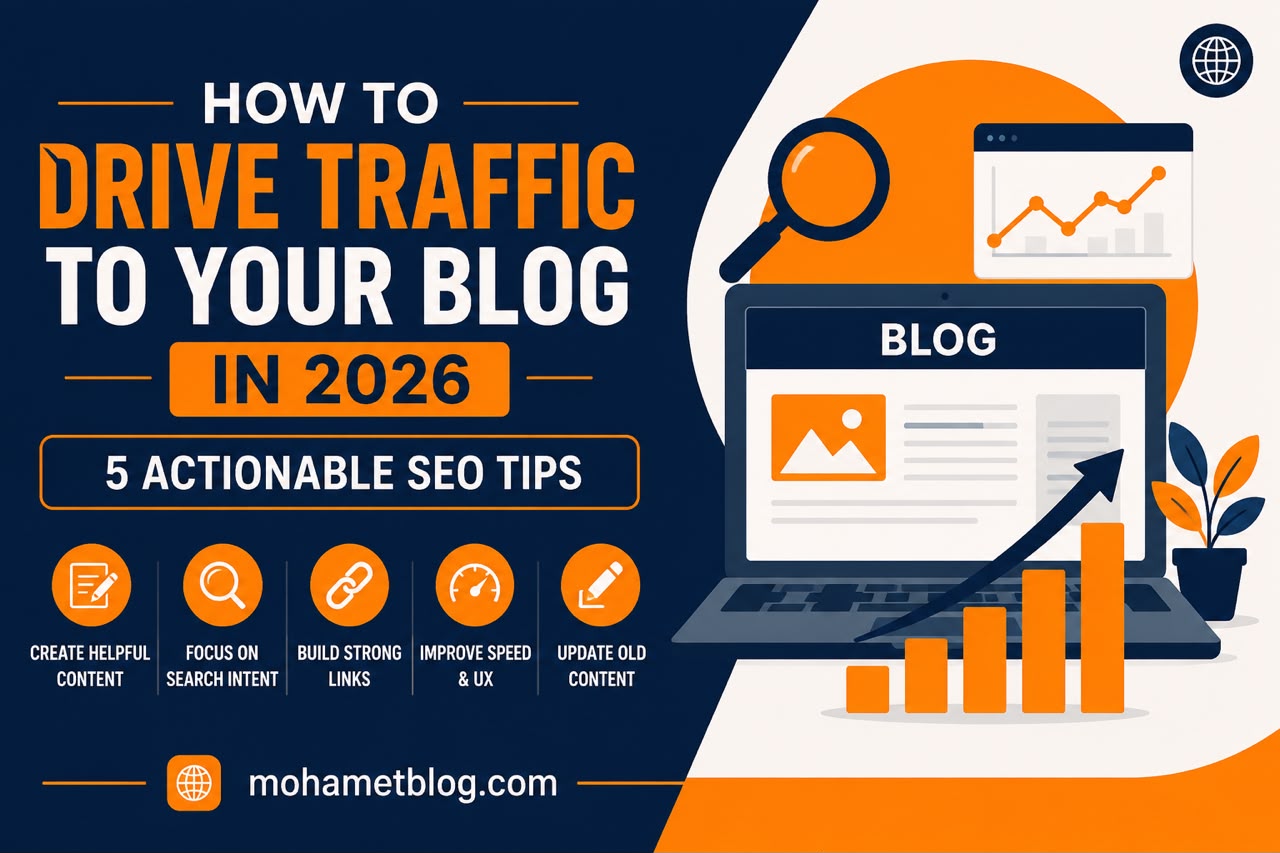
Introduction How to Drive Traffic to Your Blog in 2026
If you have been publishing blog posts but are not getting the visitors you expected, you are not alone. Many bloggers create excellent content, yet struggle to attract consistent traffic. The good news is that SEO has evolved, and in 2026 there are smarter, more effective ways to grow your audience without relying entirely on social media or paid advertising.
In this guide, How to Drive Traffic to Your Blog in 2026: 5 Actionable SEO Tips, you’ll discover practical strategies that can help increase your blog traffic, improve your Google rankings, and build long-term organic growth. Whether you’re a beginner or an experienced blogger, these SEO techniques are easy to implement and designed to work with the latest search engine updates.
Why SEO Still Matters in 2026
Search Engine Optimization (SEO) remains one of the most reliable sources of free traffic. Unlike paid ads that stop delivering results when your budget runs out, SEO continues bringing visitors for months or even years after publishing quality content.
Modern search engines focus on:
- High-quality content
- Helpful user experience
- Fast-loading websites
- Mobile optimization
- Trustworthy sources
- Content that answers user intent
Google’s goal is simple: provide users with the most useful answer possible. If your content satisfies that goal, your rankings are much more likely to improve.
1. Create Helpful Content That Solves Real Problems
The first and most important strategy in How to Drive Traffic to Your Blog in 2026: 5 Actionable SEO Tips is creating content that genuinely helps readers.
Instead of writing articles just to target keywords, focus on solving specific problems.
For example, instead of writing:
SEO Tips
Write something like:
15 Beginner-Friendly SEO Tips That Increased My Blog Traffic by 300%
The second title is more specific, useful, and encourages users to click.
Tips for creating helpful content
- Answer the main question immediately.
- Include practical examples.
- Use screenshots whenever possible.
- Add statistics from trusted sources.
- Keep paragraphs short.
- Write naturally for humans first.
Helpful content keeps visitors on your website longer, which sends positive signals to search engines.
2. Focus on Search Intent Instead of Just Keywords
Many bloggers make the mistake of stuffing keywords throughout their articles.
In 2026, Google understands context better than ever.
Ask yourself:
Why is someone searching this keyword?
If someone searches:
“How to drive traffic to your blog”
They probably want:
- Free traffic methods
- SEO strategies
- Social media tips
- Content marketing advice
Not a history lesson about blogging.
That is why matching search intent is far more important than repeating keywords unnecessarily. The ideas discussed in How to Drive Traffic to Your Blog in 2026: 5 Actionable SEO Tips are based on solving user intent rather than simply increasing keyword density.
3. Build Strong Internal and External Links
Internal linking is one of the easiest SEO improvements you can make.
Every new article should link to related articles on your website.
For example:
- Beginner SEO Guide
- Keyword Research Tutorial
- Best Blogging Tools
- On-Page SEO Checklist
Internal links help Google understand your website structure while encouraging readers to explore more content.
Add External Authority Links
Linking to trusted sources improves credibility.
Here are some excellent sources you can reference:
- Google Search Central:
https://developers.google.com/search - Google PageSpeed Insights:
https://pagespeed.web.dev - Google Analytics:
https://analytics.google.com - Ahrefs Blog:
https://ahrefs.com/blog - Moz Beginner’s Guide:
https://moz.com/beginners-guide-to-seo - Search Engine Journal:
https://www.searchenginejournal.com - Semrush Blog:
https://www.semrush.com/blog
These websites regularly publish high-quality SEO resources trusted by professionals worldwide.
4. Improve Page Speed and User Experience
Website speed has become even more important in 2026.
If your page takes more than three seconds to load, many visitors leave before reading your content.
To improve speed:
- Compress images.
- Use modern image formats like WebP.
- Enable browser caching.
- Remove unnecessary plugins.
- Use a quality hosting provider.
- Minify CSS and JavaScript files.
Also ensure your website is mobile-friendly since most visitors now browse using smartphones.
A fast website not only improves rankings but also increases conversions and lowers bounce rates.
5. Update Old Content Regularly
One secret many successful bloggers use is updating existing articles.
Instead of publishing only new content, refresh your older posts by:
- Updating statistics
- Replacing outdated screenshots
- Adding new examples
- Improving headings
- Expanding thin sections
- Fixing broken links
Google appreciates fresh and relevant content.
Updating older articles often takes less time than writing brand-new ones while delivering impressive ranking improvements.
That is another reason why How to Drive Traffic to Your Blog in 2026: 5 Actionable SEO Tips emphasizes continuous optimization rather than publishing endlessly.
Additional SEO Best Practices for 2026
Besides the five main strategies, consider implementing these additional optimization techniques:
Optimize Your Meta Title
Keep it between 50–60 characters.
Include your primary keyword naturally.
Example:
How to Drive Traffic to Your Blog in 2026: 5 Actionable SEO Tips
Write an Attractive Meta Description
Keep it under 160 characters.
Example:
Learn how to drive traffic to your blog in 2026 using five proven SEO tips that improve Google rankings and increase organic visitors.
Use Proper Heading Structure
Maintain a clear hierarchy:
- H1
- H2
- H3
- H4 (only when necessary)
This helps both readers and search engines understand your content.
Optimize Images
Always:
- Rename image files.
- Add descriptive ALT text.
- Compress large images.
- Use relevant graphics.
Add FAQ Section
How long does SEO take to work?
Most websites begin seeing noticeable improvements within three to six months, depending on competition and content quality.
Is blogging still profitable in 2026?
Yes. Bloggers continue earning through affiliate marketing, display advertising, sponsored posts, digital products, and online services.
How many words should a blog post have?
For competitive SEO topics, articles between 1,200 and 2,000 words generally perform well, provided the content is valuable and comprehensive.
How often should I publish new blog posts?
Quality matters more than quantity. Publishing one well-researched article each week is often better than several low-quality posts.
Final Thoughts
Growing a successful blog takes patience, consistency, and a commitment to helping your audience. The strategies covered in How to Drive Traffic to Your Blog in 2026: 5 Actionable SEO Tips are practical, beginner-friendly, and aligned with modern SEO best practices. Rather than chasing shortcuts or outdated tricks, focus on creating valuable content, understanding search intent, improving your website’s speed, building strong internal and external links, and updating your existing articles regularly.
If you consistently apply these techniques, you’ll be in a much stronger position to increase organic traffic, improve your search engine rankings, and grow a loyal readership over time. Remember, SEO is a long-term investment, and the bloggers who prioritize quality, relevance, and user experience are the ones who achieve sustainable success. By following the advice in How to Drive Traffic to Your Blog in 2026: 5 Actionable SEO Tips, you’ll be building a solid foundation for your blog’s growth well beyond 2026.
For more blogging and SEO tutorials, explore our latest articles to continue improving your website’s organic traffic .https://mohametblog.com/top-5-essential-tools-for-beginner-bloggers/
Pingback: Top 5 Essential Email Marketing Tools for Beginners in 2026
Pingback: Canva vs Photoshop: Which Tool Is Best for Bloggers in 2026?
Pingback: Best AI Website Builders in 2026: Without Coding